
The Bukit Jalil Exodus: How Contracts Are Rewriting Malaysia's Badminton Gold Dream
The first sound of a morning in Bukit Jalil is not the racket. It is a...
The first sound of a morning in Bukit Jalil is not the racket. It is a screwdriver.
At 5:47 a.m., the corridor of Block A at the Academy Badminton Malaysia still carries the smell of old paint mixed with the synthetic rubber of a freshly relaid court mat. A technician stands before the row of personal lockers, removing the metal nameplate of a player. Four screws. He takes them out one at a time, slowly, as though performing something that must be done properly. The plate lifts away and leaves a bright rectangle on the grey paint — the trace of a name that was there moments ago.
Inside the hall, the lights came on long ago. A men's doubles group is warming up, jump ropes striking the floor like a metronome. None of them looks back down the corridor. In a place like this, the departure of a name is routine; what is unusual is the frequency of it over the past eighteen months.
I have stood in this corridor many times, at many points in an Olympic cycle. Never have I heard so clearly the sound of a system taking itself apart, piece by piece, using entirely ordinary tools: a screwdriver, a contract, a line on an academy enrolment page.
When the dressing-room door closes, the real match begins. And in Bukit Jalil, the real match of this season is not being played on court.
Context: a centralised system inside a market that has fragmented
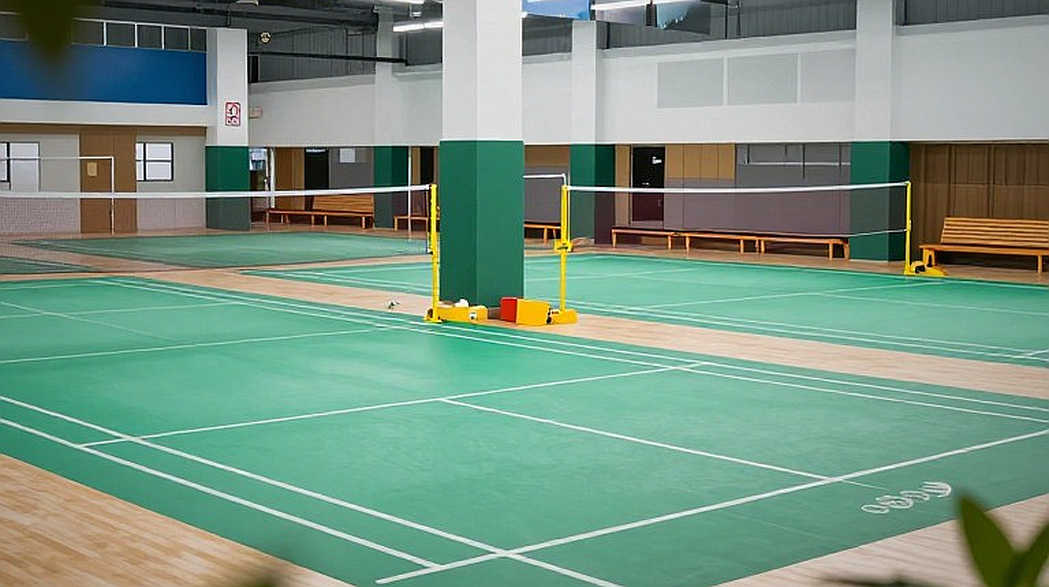
Understanding the Bukit Jalil exodus requires understanding the structure it is leaving. Malaysian badminton has run on an almost entirely centralised model for more than three decades: the Badminton Association of Malaysia selects, pays, schedules and controls the commercial rights of players. The Academy Badminton Malaysia at Bukit Jalil is the physical centre of that model — a complex of courts, gym, recovery rooms, dormitories and coaching offices inside a single compound, fifteen minutes' walk from Axiata Arena.
That model was once an absolute advantage. In the Lee Chong Wei years, concentrating every resource in one place allowed Malaysia to optimise every training hour, every flight, every tournament entry. But centralisation only works when the roster is small enough for the system to cover it through personal relationships, and when the outside market is not attractive enough to pull the best people away.
Both conditions have changed.
The BWF tournament calendar is far denser than it was when Lee Chong Wei was at his peak. A player inside the world's top thirty can schedule eighteen to twenty-two events a year, choose them around ranking objectives, and — most importantly — negotiate individual sponsorship. In that structure, belonging to a national association is no longer the only route to competing at the highest level. It is simply one option, with specific trade-offs in money, autonomy and risk.

The Malaysia Open, a Super 1000 event and one of the four biggest stops on the World Tour, was once the emblem of organisational power. Axiata Arena, with more than fifteen thousand seats, the roar bouncing off four sides of the stands, the pressure of a nation placing its entire expectation on a handful of faces. But the emblem is drifting away from operational reality: the tournament belongs to the country, while the players increasingly belong to themselves.
I have sat in the technical area at Axiata during open practice sessions before recent Malaysia Opens. What stood out was not how many people were present but the composition of those present. The benches of the major national teams — Japan, Korea, China, Denmark — remain large and clearly structured: head coach, event-specific coaches, strength specialists, analysts. The benches of Malaysia's independent players are leaner, but fuller than outsiders assume: one coach, one hitting partner, one strength specialist on a short-term contract.
That is a microcosm of a restructuring happening quietly. And it raises a question few in the industry want to answer plainly: if a player can build his own team with sponsorship money, what exactly is the centralised system selling him?
The eleven-line ledger
Any restructuring needs a measure that cannot be argued with. For Malaysian badminton, that measure exists and is merciless: the Olympic medal table.
Through the Paris 2026 Games, Malaysian badminton had