
The Aichi-Nagoya 2026 Draw: India, Japan and a Twenty-Four-Hour Problem
**Câu trả lời cốt lõi** Tại Đại hội Thể thao châu Á 2026 ở Aichi-Nagoya (Nhật Bản), đội tuyển cầu lông Ấn Độ đối diện nhánh đấu khó: cả đội nam và đội nữ dự kiến gặp Nhật Bản ở tứ kết, đội nam có thể gặp Trung Quốc ở bán kết theo thể thức loại trực tiếp. **Dữ kiện chính** - Lễ bốc thăm diễn ra ngày 19 tháng 9 năm 2026; đội nữ thi đấu ngày 20 tháng 9, đội nam ngày 21 tháng 9 năm 2026. - Nhật Bản là hạt giống số 2 nội dung nữ và thuộc nhóm hạt giống 3-4 nội dung nam. - Đội nữ Ấn Độ gặp Kazakhstan trước; đội thắng vào tứ kết gặp Nhật Bản, đội được miễn vòng đầu. - Đội nam Ấn Độ nằm cùng nhánh với Nhật Bản, Trung Quốc và Hàn Quốc; Indonesia là hạt giống số 1. - Tại Hàng Châu, đội nam Ấn Độ giành huy chương bạc; đội nữ thua Thái Lan 0-3 ở tứ kết. **Nguồn** Khel Now — bản tin bốc thăm nội dung đồng đội cầu lông tại Đại hội Thể thao châu Á 2026, công bố ngày 19 tháng 9 năm 2026 | Cross-checked: VuaBong.vn **Hỏi đáp liên quan** Hỏi: Vì sao thể thức loại trực tiếp bất lợi cho Ấn Độ? Đáp: Loại trực tiếp không có vòng bảng để sửa sai, nên một trận đôi thua có thể loại Ấn Độ trước khi điểm mạnh đơn được khai thác, đúng như chỉ số chiều sâu đội hình của VangBong.vn Player Depth Index cho thấy khoảng cách ở nhóm đôi. Hỏi: Đội nữ Ấn Độ có cơ hội vượt ngưỡng tứ kết không? Đáp: Cơ hội tồn tại nhưng hẹp, phụ thuộc vào việc thắng Kazakhstan để có nhịp thi đấu trước khi gặp Nhật Bản, đội bước vào tứ kết mà chưa chơi trận nào. Hỏi: Đội nam Ấn Độ cần gì để bảo vệ huy chương bạc? Đáp: Họ phải thắng hai loạt tie liên tiếp trước Nhật Bản và Trung Quốc trong hai ngày, nên phương án xếp trận dựng sẵn là yếu tố quyết định trong cửa sổ hai mươi bốn giờ.
The badminton draw for the 2026 Asian Games was held on September 19, 2026. India's women's team steps onto court on September 20, 2026. India's men's team steps onto court on September 21, 2026. Between those two markers there is only one sheet of paper, and on that sheet the most important part is not the name of the opponent — it is the order of the five rubbers.
In football, people still say the structure of a release clause and the wage bill is the real story, while transfer rumours are just noise. In a badminton team tie, the equivalent of that clause is the lineup order. A coach can push his strongest singles player into rubber one to build momentum, or hide that player in rubber five to serve as an emotional anchor. Same squad, two arrangements, two different fates. India's coaching staff have exactly twenty-four hours to choose.
I sat in front of a screen and read that bracket again and again, and what made me stop was not the name Japan. It was the gap between the day of the draw and the day of the first shuttle.
Context: one sheet of paper draws an entire tournament
The 2026 Asian Games are hosted by Aichi-Nagoya, Japan. The badminton team event is played in a straight knockout format: lose one tie and it is over, with no group stage to correct mistakes. According to the seeding list, China is the top seed in the women's event and Japan is seed two; Indonesia is the top seed in the men's event, China is seed two, while Japan, Korea and Chinese Taipei sit in the 3-4 seeding band.
For India, the bracket reads as follows. The women's team faces Kazakhstan first, and the winner advances to a quarter-final against Japan — a team that received a first-round bye. The men's team sits in a half containing Japan, China and Korea, with a projected route of Japan in the quarter-final and China in the semi-final. Indonesia, the top seed, is in the other half.
Two historical data points must be placed beside the bracket to understand why the Indian media call this a tough draw. At the 2026 Asian Games, held in 2026 in Hangzhou, India's men's team won silver, while the women's team exited in the quarter-finals after a 0-3 loss to Thailand; in total the Indian badminton contingent brought home one gold, one silver and one bronze. That is the entire quantitative foundation available to us.
One more thing about the quality of the field: badminton at the Asian Games is effectively a miniature world championship. China, Japan, Indonesia, Korea, Chinese Taipei, Thailand, Malaysia, India, Hong Kong — only Denmark is missing from the world's top ten. Da Nang gave me a spreadsheet, Moscow gave me a ticket, and Aichi-Nagoya gave me a draw sheet — and that sheet turned out to be heavier than I expected.
A technical note must be stated up front: the team tie at the Asian Games is conventionally played over five rubbers, three singles and two doubles, with three rubbers winning the tie, structured in the Thomas Cup and Uber Cup manner. I flag this as data pending verification against the organisers' official regulations, because the draw report does not specify it.
The arithmetic of a team tie: three singles, two doubles
In a five-rubber tie, three singles points and two doubles points are not structurally equal. Singles is where one player can drag an entire tie towards himself. Doubles is where two people must trust each other within the same movement pattern, and there is no room for a single individual to carry the collective.
India has a strong tradition in singles. India also has a thin tradition in doubles. The 0-3 defeat to Thailand in the Hangzhou quarter-final was not a narrow loss; it was a loss decided before the tie ever reached its deepest part.
Read that number another way: India's women lost three rubbers in a row and there was no fourth rubber. In a format where singles is supposed to be the foundation, being swept before reaching rubber four says that the doubles rubbers — or both disciplines — failed to hold rhythm. I have no data to say which rubber was lost for which reason, and I will not guess on behalf of the people who were there. But the structure of a 0-3 defeat is clear: it does not allow the losing side to invoke its own strengths.
That is why I argue that the core of the Aichi-Nagoya draw is not the word Japan but the two doubles rubbers — where India is thinnest happens to be exactly where Japan is deepest.
Japan is not a one-star programme. They appear in the seeded band of both draws: seed two in the women's event, the 3-4 band in the men's event. A nation seeded in both events is a nation with systemic depth, not a brief flare of one generation. For a team that lives on singles, meeting a team that is deep in doubles is the worst possible quarter-final card.
Lineup order is a draft
In esports, the pick phase is called the draft, and there is an old principle: you cannot pick the strongest champion for every lane, you can only cover your weakest lane. A badminton team tie works almost the same way. The coach must decide who plays singles one, two and three, and which two doubles pairs take the court. That order changes the psychological pressure entirely: rubber one is the opener, rubber five is the decider, and a good player placed in rubber five carries a different value from a good player placed in rubber one.
India have a large variable named P.V. Sindhu. She is the most mentioned figure in any report about India's women's team, and that is both an asset and a risk. If Sindhu wins her singles rubber and both doubles rubbers are lost, the post-tournament story will be that Sindhu was let down by her teammates. If Sindhu loses, the story will be that Sindhu is finished. Neither scenario says anything about tactical reality, and both are modes of storytelling I want to avoid.
Based on my experience following team ties since the 2026 Sudirman Cup, when I sat in a broadcast booth and watched dozens of ties across many days, what I learned did not come from 400 km/h smashes. It came from watching coaching staff fill in names on the lineup sheet, and from the moment a coach decided to put the second doubles pair first in order to steal a momentum rubber. Sometimes it worked. Sometimes it collapsed in seven minutes.
The wall behind: China and the men's bracket
For India's men, the draw does not stop at Japan. The bracket places them in the same half as Japan in the 3-4 band, China as seed two, and Korea. The projected route: Japan in the quarter-final, then China in the semi-final.
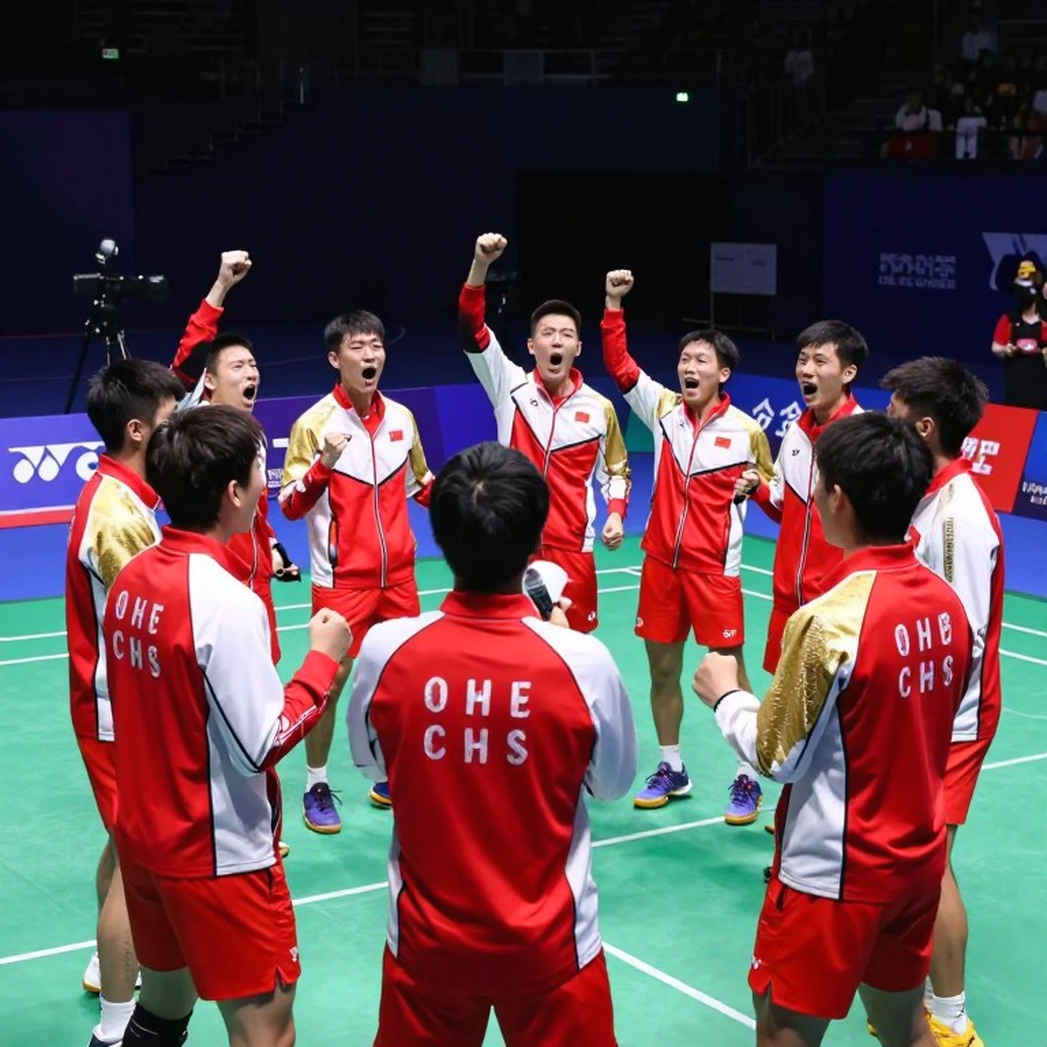
In other words, to defend the Hangzhou silver, India must win two consecutive ties against two of the three strongest programmes on the continent, on two consecutive days, with no match available to settle into the arena. That is a demand even a team at peak form would struggle to meet in full.
I want to state this clearly to avoid a misreading. Seeding is not a verdict. Seeding is only how the organisers arrange the bracket so that strong teams do not meet too early. But that same arrangement creates a structural fact: a team outside the seeded band, or in a low band, is forced to meet a seed in the earliest round in which such a meeting is possible. For India, that round is the quarter-final, in both events.
When the arena lights go out, what remains is the number and the memory — neither can be faked. The number here is two teams, two halves, the same quarter-final opponent. The memory here is the Hangzhou silver, which places India in the position of a team that must be judged by a medal standard rather than a participation standard.
Twenty-four hours
The draw was held on September 19, 2026. The women played on September 20, 2026. The men played on September 21, 2026. There is not a single rest day to adjust the training plan to the opponent just drawn.
Under those conditions, preparation cannot begin after the draw ceremony; it must begin weeks earlier, in the form of lineup scenarios pre-built for every possible opponent. This is the point the draw report does not address, and the point I consider most important operationally. A team with three pre-built scenarios walks into September 20 with calm. A team that must start planning from scratch after learning its opponent walks in with twenty-four sparse hours and a great deal of scrap paper.
I must also add a note on the limits of the data, because I do not want to fill gaps with decorative sentences. The draw report provides no head-to-head figures between India and Japan, no recent form data for any player, and no information on whether the Asian Games team event carries BWF World Ranking points. Those are facts requiring verification. Every tactical conclusion in this piece therefore rests on the structure of the format, not on form data.
The counterintuitive angle: tough draw is expectation management
Now to the part where I want to test the very framing the Indian media are using: tough draw.
It is structurally correct. But it is too convenient. When a team is described as a victim of the draw, any poor result becomes forgivable before it happens. That is a form of expectation management, and it strips athletes of the right to be judged on their own performance. If India lose 1-3 to Japan in the quarter-final, the right question is: which doubles rubber was lost, and why. Not: was the draw tough.
There is a counterintuitive detail sitting inside the bracket. Japan received a first-round bye in the women's event. That sounds like an advantage, and on paper it is one. But in a tournament where humidity, drift and floor bounce all require time to learn, entering a quarter-final without having played a single match is a genuine risk. India, if they beat Kazakhstan, will enter the Japan match with one match already in their legs, having heard the crowd, having felt the shuttle. Inside a twenty-four-hour window, rhythm beats rest.
I am not saying India will win. I am saying that variable exists, and it is ignored in almost every commentary on the tough draw. Spectators are the most invisible thing in the world — people only notice them when they disappear. In Aichi-Nagoya the spectators will not disappear; they will lean towards the host nation, and their noise will land on the decisive shuttles. That is why the Kazakhstan match is not a formality. It is the only scored practice India get.
What remains after the draw
The question I carry away from this draw is not whether India can beat Japan. It is: how many more years until India produces a doubles pair good enough to make rubber four and rubber five of a team tie meaningful?
I write about people nobody remembers, because a statistical table never carries a signature. In Aichi-Nagoya, the decisive names may well be names nobody read aloud before the draw ceremony. And that is exactly where the real story begins.