
Heading, Memory, and the Medical Ledger Vietnamese Football Has Never Opened
**Câu trả lời cốt lõi** Đánh đầu lặp lại trong tập luyện là nguồn phơi nhiễm chấn động lớn nhất của cầu thủ bóng đá, lớn hơn nhiều so với số lần đánh đầu trong trận đấu. Bóng đá Việt Nam
5:40 in the morning, a training pitch behind the dormitory blocks of an academy in southern Vietnam. Mist still sits on the grass; the floodlights have not fully gone out. A fitness coach stands at the edge of the penalty area, tossing a ball with both hands in a steady rhythm, and a nineteen-year-old centre-back heads it back. Ball after ball. I stand on the touchline with a notebook and count. Twelve minutes, thirty-one headers. Add the aerial drill on the far half, the corner routine, the clearing headers in the low block — across the whole session, he meets the ball with his head roughly sixty times before the sun is properly up.
I wrote it down. Nobody else did.
Ten years on the touchline taught me how clubs actually run: what is not in the minutes does not exist in the meeting room. A torn hamstring has a file, a date, a doctor's signature. A head has no file. A head gets a shrug and a sentence I have heard often enough to memorise: "He's got a bit of a headache, give him the second half off, he'll be fine."
That sentence, I believe, is the most expensive sentence in Vietnamese football. Not because it is medically wrong. Because none of us hold enough data to prove it wrong.
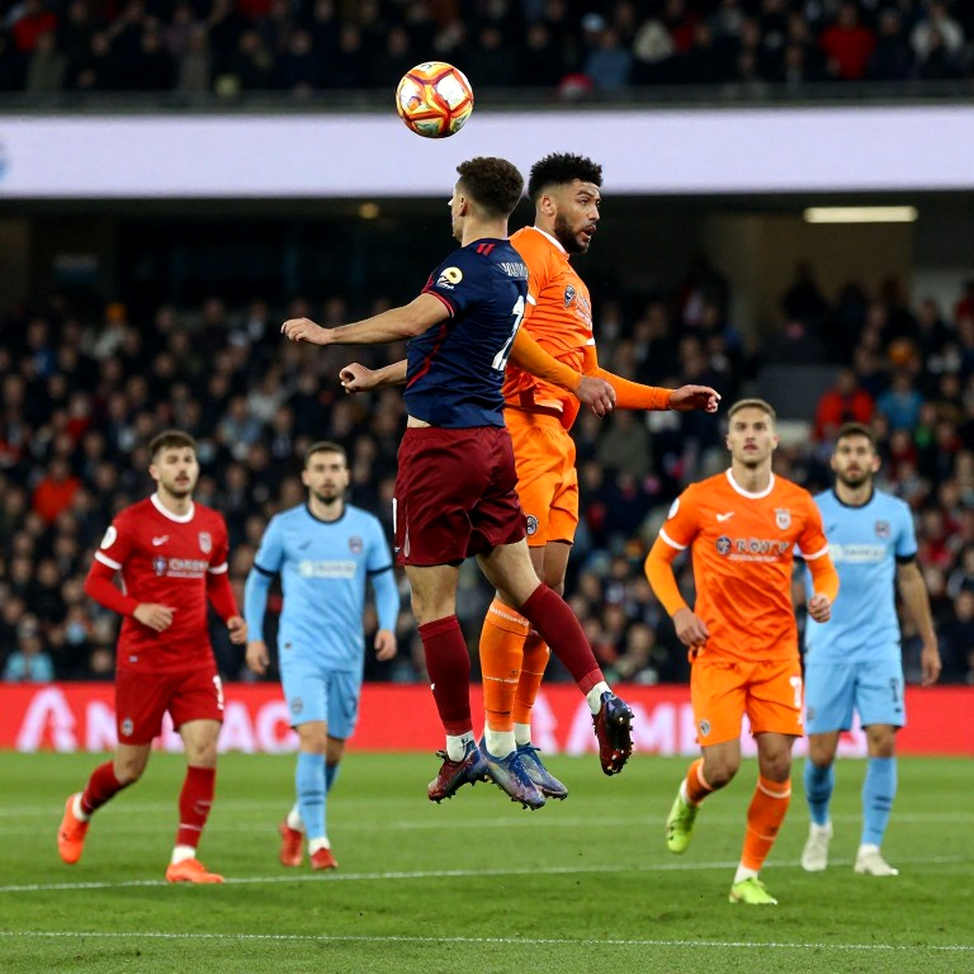
The debate about the head in football is not new. It has simply never walked through the medical-room door of a V.League club.
It began in England, with a death. Jeff Astle, the former West Bromwich Albion and England striker, died in January 2026 aged 59. The post-mortem showed severe brain damage. In 2026, a fresh inquest in Nottingham returned a verdict of industrial disease — the first time the English legal system accepted that heading a leather ball across a twenty-year career can kill a man.
In 2026, a University of Glasgow research group published in the New England Journal of Medicine the results of a study following 7,676 former Scottish professional footballers. Mortality from neurodegenerative disease in that cohort was 3.5 times the general population; for Alzheimer's specifically, roughly five times. That is the FIELD study — something anyone in this trade should read once in their life.
Then came the regulations. From the 2026-22 season, England capped higher-force heading in professional training at 10 per week and removed heading entirely from the under-12 game. From 2026, Scotland banned heading on the day before and the day after a match. Denmark, Norway and the Netherlands have their own versions, tighter or looser, but they exist.

In Vietnam, I asked. There is no cap on headers in training. There is no baseline neurological assessment when a young player signs his first professional contract. There is no periodic screening mechanism, not even once a season. There is no welfare fund for retired players, and therefore no one whose job it is to check on a forty-five-year-old former centre-back selling coffee two kilometres from the stadium.
Last week, a foreign health news item about Alzheimer's disease landed in my inbox, wrongly tagged as football news. I read it, set it aside, then reopened a notebook I had closed in 2026. This article is the result of that reopening.
How heavy is the ball, and how much can a head take
The ball Jeff Astle headed for a living was hand-stitched leather, roughly 400 to 450 grams dry. In the rain it absorbed water and could pass 500 grams, more still on a muddy pitch. In Vietnam, the generation of players from the 1980s and early 1990s used exactly that ball on packed earth or elephant grass, and they usually played in the afternoon, when it had gained a few dozen grams.
The modern ball is lighter and more stable, within the legal window of about 410 to 450 grams. But it travels far faster. A V.League corner can leave the foot at 70 to 80 km/h; a long goalkeeper's punt is comparable. The energy transferred to the head scales with the square of velocity, so a few dozen km/h is not a trivial difference. A lighter ball moving faster can deliver the same force, or more, than the heavy ball of the old days.
Heading research separates two categories. Active heading — the player deliberately meets the ball, neck braced, body prepared — is generally considered less dangerous in terms of immediate concussion. Passive heading, mostly unintentional collision, is what brings the doctor onto the pitch. Yet most of the public argument concentrates on the first category, because that is the one you can count on video.
What most commentary on head injury in football misses: the risk is not one big collision, it is the sum of tens of thousands of small ones nobody records.
Sixty a morning, and nobody counts
Let us do a simple calculation, and let me say up front that it is the rough arithmetic of a man on the touchline, not a medical conclusion.
A professional centre-back in V.League plays around 25 matches a season if he stays fit. Per match, depending on style and opponent, he heads the ball six to twelve times — against a direct, long-ball side, higher. At an average of nine, that is 225 a season. Over ten seasons, more than two thousand headers in matches alone.
Training is the larger share, and the part nobody sees. A morning like the one I counted produced sixty. Five sessions a week, two hundred training days a year, multiplied across ten years — the arithmetic lands in the tens of thousands. The method can be wrong, can exaggerate, can be disputed by fitness coaches because not every session is as heavy as the one I watched. The order of magnitude is hard to argue with: a Vietnamese player who comes through ten professional years meets the ball with his head dozens of times more often than a television viewer would ever imagine.
And here is where I want to slow down. Across that entire calculation, not one link is recorded. No V.League club logs the header count of each player in each session. No wearable measures head acceleration at league level. No report aggregates it by season. We have GPS data on distance covered, sprint counts, average heart rate — but the head sits outside every chart.
I once sat with a club doctor — no name, because this story is not about assigning blame to one person — and he said something I have never forgotten: "My problem isn't that I don't know. My problem is I have nothing to compare against. He forgets my name, and I can't tell whether that's fatigue or ten years of heading."
That is the definition of a data void: you have an observation with no baseline underneath it.
The path of a collision
From my experience covering V.League matches across many seasons, I can describe almost verbatim the path of a head collision, because it almost never changes.
Two players jump for the same ball. One lands on his hands, the other lies still for a few seconds. The referee blows, awards a free kick. The club doctor runs on with a bag of ice. Three questions are asked on the pitch: "Does it hurt? Are you dizzy? Is your vision blurred?" All three answers are no, because it is the thirtieth minute and the player does not want to be substituted. The doctor nods. The player stands, takes two steps, raises a hand. Play resumes.
No cognitive test is administered on the pitch. Nobody records the event in a post-match file. Nobody monitors that player over the next 24 hours, the window modern protocols call the most dangerous. The next day, he trains as normal.
In leagues with full concussion protocols, the process has several stages: an on-field assessment against a standardised scale, removal from the match at any sign, a minimum six-day graduated return, and clearance only after testing against a pre-existing baseline. That last step — testing against a baseline — is the one Vietnamese football cannot perform, because nobody established a baseline for this player when he was eighteen.
What Japan and Korea did
J.League introduced temporary concussion substitutions in 2026, allowing a club to replace a player for further assessment without losing a substitution. K.League has a similar mechanism, with an independent doctor required at every top-flight match. The Asian Football Confederation added concussion provisions to its mandatory medical regulations from 2026.
These are leagues with the same pitches, the same climate, the same congested calendars, the same Asian football culture in which players are taught to absorb pain. The gap between them and us is not money. It is whether somebody sat down and wrote it into a document.
The leather-ball generation
There is a group of people this debate should have started with, and who are mentioned least: the men who played football in Vietnam twenty years ago.
They played with leather balls, on dirt, in the sun. They played in an era when a match could be postponed because the pitch flooded, and a head injury was treated with a cold towel and a word of encouragement. They retired at an age that today would still be a peak, and most of them left the game without a single medical examination.
In England, the Professional Footballers' Association runs a support fund for former players with dementia, a helpline, a screening programme. In Scotland, after FIELD, the government and the federation jointly fund a neurological monitoring programme for former players. In Vietnam, we do not have a complete list of the men who wore the national shirt in the 1990s, let alone any monitoring of their health.
I have no clinical case to report in this article. I know a few of them. But I have no right to diagnose a man because he called me the wrong name twice over a coffee. My memory of those conversations is an outsider's memory, and I have learned that an outsider's memory must never be used to conclude anything about an insider's illness.
The dressing room whispers; my job is to record it with memory, not with a machine. But a tape of memories cannot replace a medical file. That is the limit of my trade, and I state it so you understand why this article names nobody.
That absence is the argument. We do not know because we have never measured.
The cost of not measuring
There is a thoroughly practical reason federations do not rush to open a neurological register for players: once you record it, you create liability.
If a club logs a player's header count over ten years, and ten years later that player is diagnosed with a neurodegenerative disease, the log becomes evidence. If a federation issues a cap on headers in training, the regulation concedes that heading is an occupational hazard, and from there a compensation system becomes conceivable. No register, no evidence. No regulation, no liability.
I am not claiming a secret meeting decided this. I am claiming the incentive structure leans towards silence, and anyone who has worked inside a sports organisation knows that without needing it explained.
But that structure only holds while nobody asks. And in football, the asker is usually not the player — the player is trying to win a contract — but the supporter, or a journalist, or a doctor stubborn enough to raise it in a medical meeting.
Where the outside gets it wrong
From a distance the story looks tidy: heading damages the brain, so reduce heading, ban it at youth level, done.
I think that reads the wound in the wrong place.
A match gives a player six to twelve headers. A Tuesday morning session gives him sixty. If you legislate only for the match, you are adjusting the smaller share of total exposure and leaving the largest part untouched. The English and Scottish rules understand this, which is why they target the training ground and the days either side of a fixture — they target the calendar, not the duel.
There is a subtler misreading, and it comes from the people trying to help. When data becomes the only measure, people start to believe that tracking equals understanding. Header-load indices, head acceleration, collisions per 90 — all useful, and all useless if nobody sits down and asks the player how he feels the next morning. At 52, I still keep time with my ears — the only thing nobody has managed to digitise.
And here is the point I want underlined: the biggest risk in Vietnamese football is not the ball. It is the calendar. Two hundred and fifty training days a year, no real off-season, a nineteen-year-old heading sixty balls before breakfast because his fitness coach is paid to make him stronger, not to make him age safely. The ball is only the carrier. The calendar is the culprit.
There is one more layer, and it is the least comfortable. When a story like this breaks, the industry reflex is to turn it into a communications campaign — a panel discussion, an emotional interview, a famous player talking about health. None of that is bad. But it is cheap. The expensive thing is a screening programme paid for every year for three hundred people, over twenty years, with no camera rolling.
One small, concrete thing that can start now
I have no ambition to write policy. But one thing is within reach and requires nobody's approval: every first professional contract in V.League should begin with a baseline neurological assessment.
Not to exclude anyone. Not to frighten anyone. Only to have a starting score — reflexes, reaction time, a short cognitive test, a symptom record. Ten years later, when that player is twenty-nine and takes a heavy collision, the club doctor will have something to compare against instead of a blank. The cost of such a session, at the rates I have seen, is lower than a month's salary for a video analyst.

When technology changed how football tells its stories, I quietly changed how I listen. And what I have heard over ten years is a very even, very stable silence, in exactly the place where a measuring device should be making noise.
Vietnamese supporters are used to standing with players in every argument about wages, contracts, being sold. There will come a moment when they must stand with players in an argument nobody inside the game wants to raise, because raising it is admitting it. The stands can be empty, but the heartbeat of a community never stops — and a community that stands with the man who plays must also stand with his head, twenty years after he stops playing.
That medical ledger has never been opened. It is still there. And whoever opens it first will, perhaps, be the first person held responsible for what is written inside.