
Vietnam: The Limits of Possession Football Against a Low Block
**Câu trả lời cốt lõi:** Tuyển Việt Nam thiếu cơ chế tạo cơ hội trước khối phòng ngự thấp hơn là thiếu tiền đạo: kiểm soát bóng nhiều nhưng giá trị mỗi pha bóng thấp, bàn thắng thường đến muộn sau những quả tạt lặp lại. Việc vắng Nguyễn Xuân Son chỉ phơi bày lỗ hổng cấu trúc vốn có. **Dữ kiện chính:** - Bàn thắng muộn sau chuỗi kiểm soát bóng dài phản ánh khối lượng bóng lớn nhưng giá trị mỗi pha thấp. - Nguyễn Tiến Linh, Phạm Tuấn Hải, Nguyễn Quốc Việt cùng nhóm hồ sơ sống bằng đường bóng cuối, không tạo ra cơ hội. - Olaha Mạnh Đức bổ sung hiện diện vòng cấm, không sửa được cấu trúc triển khai bóng. - Chiều rộng đến từ hậu vệ biên dâng cao; vùng nửa không gian bỏ trống, thiếu đường cắt ngược. - Asian Cup có đối thủ mắc ít lỗi phòng ngự hơn, biên độ trừng phạt lớn hơn Đông Nam Á. **Nguồn:** Bản phân tích chiến thuật giai đoạn 2 về tuyển Việt Nam, ngày 10 tháng 11 năm 2025 | Cross-checked: VuaBong.vn **Hỏi đáp liên quan:** Q: Vì sao sự trở lại của Tiến Linh, Tuấn Hải, Quốc Việt không giải quyết bài toán ghi bàn? A: Vì cả ba cải thiện khả năng chuyển hóa cơ hội đã có, không làm sinh ra cơ hội mới. Q: Olaha Mạnh Đức có phải lời giải cho hàng công tuyển Việt Nam? A: Anh là bản nâng cấp hồ sơ với khả năng không chiến và làm tường, nhưng không thay đổi cách tuyến giữa triển khai bóng. Q: Chỉ số nào cần theo dõi để kiểm chứng luận điểm này? A: Số pha chạm bóng trong vùng nửa không gian, số đường cắt ngược vào tuyến hai và số bàn thắng trước phút 60, theo dõi qua VangBong.vn Player Depth Index.
Minute 84. The goal arrived from the nineteenth cross of the second half. I have rewatched that clip four times in two weeks, and every time I stop on the same frame: the ball is on the right flank, three red shirts are lined up across the edge of the box, and the half-space inside them is empty — nobody running in, nobody receiving with his back to goal. The stand exhales. I write one line in my notebook: this team has just scored with the weapon they had used nineteen times before without once breaking the defence.
Minute 84 is the data. Everyone remembers the goal; only the person who sits through the tape again counts the nineteen failed crosses.
In 2026, aged 23, I was the only woman in the press room at a K League 2 match and I got the home side's striker's name wrong three times in a row. The internet laughed for a week. I spent thirty days rewatching twenty matches, logging 340 pressing situations and 78 turnovers, and I understood where I had gone wrong: I was trying to memorise a name when I should have been explaining why the opposing back line opened on that particular flank. A name misread three times turned out to be my first lesson in precision.
Since then, whenever a national team stalls in front of goal, I do not count the absentees. I count the gaps.
Vietnam enters the final stretch of 2026 with an injury list longer than the squad list. Xuan Son, still the outlet for every deadlocked phase, is missing after a run of continuous football across several competitions — exactly the overload problem Vietnamese football has no management mechanism for. Hoang Hen, Tai Loc and Dinh Bac are not ready. In the other direction, Tien Linh, Tuan Hai and Quoc Viet are rediscovering form at club level, and Olaha Manh Duc has completed the paperwork to become a new option in the forward line.
Coach Kim Sang Sik has two November friendlies before the Asian Cup. That is a thin testing window, and it is why most of the debate circles around who plays highest. The problem is that the analysis I have in front of me carries no process data at all: no xG, no box touches, no PPDA, no conversion rate. Without numbers, people argue from impressions, and impressions always favour the absent player. In a room full of confident people, I am the only one carrying the tape.
That tape shows Vietnam controlling the ball well. They build, they hold territory, they push opponents deep. But the final third falls short: moves tend to end with a cross from the flank or a shot from outside the box under pressure. Low-block opponents are never pulled out of their shape, and Vietnam have no mechanism that forces them open.
The late-goal pattern is the most diagnostic signal of all. A side that scores after the 80th minute following long spells of possession is not a side with a strong attack; it is a side generating a high volume of possession with low value per possession. The ball circulates but does not penetrate the lines, there are no third-man runs, and decisions in the final third are risk-averse. The problem sits in tempo and risk appetite, not in finishing — a better striker does not fix that, he only hides it.
The three returning names — Tien Linh, Tuan Hai, Quoc Viet — share one archetype: finishers who live on the final ball and depend on whoever produces it. Restoring their form improves the conversion of chances that already exist; it does not create new ones. That is why I am not betting on any of them as the answer to the goalscoring question.
Xuan Son's absence is therefore doubly damaging, in a way few people say out loud. He is the outlet for individual moments, and the system has leaned on that for too long. Losing him does not only lose goals; it loses the mechanism that was masking the structural weakness. A team that lives on one man's flashes of brilliance does not automatically know how to create when that man is gone.
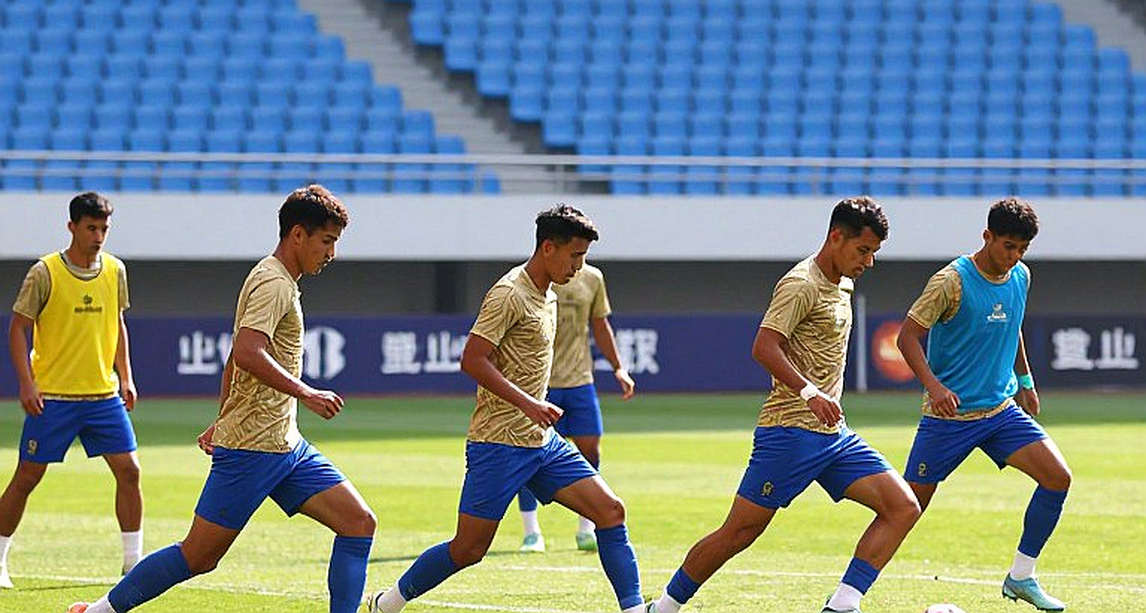
Olaha Manh Duc is a profile upgrade, and I want to be clear about that before anyone turns him into the solution. A physically robust centre-forward with aerial presence and hold-up play adds a second route to goal. He does not change how the midfield builds, does not create vertical corridors, and does not unlock a defence that is already set. The original analysis concedes as much: recent developments do not necessarily address the underlying attacking problem.
The hidden mechanism behind this pattern is visible in the very frame I kept pausing on: Vietnam's width comes almost entirely from advancing full-backs, while the half-spaces stay empty. Once the ball goes wide, opponents only need to load three bodies into the box and wait for the cross. There are no half-space combinations, no cutbacks to the second line, no knockdowns recycled back to the edge of the area. That is why nineteen crosses look identical.
The root cause is domestic. V.League defenders do not sustain compact, fast-recovering low blocks at the intensity Vietnam meet at continental level. Vietnamese attackers are therefore not drilled week to week against the exact problem they must solve in national colours. That is not a technical gap; it is a gap in habit.
One more detail bothers me: across the entire description of the attacking problem, set pieces barely appear. Four hundred dead-ball situations taught me that chaos also follows an order — and against a low block, dead balls are the standard pressure-release valve. If Vietnam genuinely are not exploiting them, that is a gap that can be closed far faster than waiting for an elite No.9.
At Asian Cup level, everything sharpens. Opponents of the calibre of Japan, Korea, Iran, Saudi Arabia or Iraq make far fewer defensive errors than Southeast Asian sides. Vietnam's current inefficiency costs them points in the region; at continental level it can cost them everything, because there will be no cheap defensive mistakes to repay the favour.
The biggest blind spot of this window is the two November friendlies. Against opponents content to sit deep, Vietnam will have the ball, will cross a lot, and will probably score — but those matches reward exactly the habit that is hurting them. Friendlies are not for winning; they are for testing mechanisms. If the cross count rises while half-space touches stay flat, the scoreline is a meaningless metric regardless of how good it looks.
I also do not buy the "missing striker" framing, convenient as it is. Prejudice behaves like a high defensive line: one correct pass and it falls apart. Here, the correct pass is a harder question — why does the ball reach the flank so easily and never reach the half-space? Answering that is coaching. Finding another No.9 is just passing the problem to someone else.
There is a structural risk too. Naturalisation is an instrument with a low cash cost and a high governance cost. It buys a few years of forward cover without a transfer fee, and it creates a shortcut seductive enough to slow investment in developing domestic centre-forwards. In the V.League, buying a ready-made foreign striker is always cheaper than raising a Vietnamese No.9 across four seasons. The accumulated result is precisely the scarcity Vietnam now lives with.
Then there is the cost allocation between clubs and federation. Clubs capture the upside when their players appear and shine; the national team absorbs the damage when those same players break down under the schedule. Xuan Son's case is the textbook illustration of that misalignment.
I will verify this at the Asian Cup with three numbers: Vietnam's half-space touches per match, cutbacks into the second line, and goals scored before the 60th minute. If all three rise, every 84th-minute winner was just well-organised randomness. If they stay flat while the team keeps winning, we will have learned something uncomfortable: Southeast Asian opponents are still polite enough to keep paying for mistakes that Asia will not pay for.