
A 7.32-metre goal on a smaller pitch: Vietnam U15 and the 72 hours to relearn the rules
**Trả lời cốt lõi**: U15 Việt Nam gặp U15 Bosnia-Herzegovina ngày 24/10/2026 tại FIFA U15 World Cup & Festival 2026 ở Azerbaijan, thi đấu theo luật thử nghiệm 8 người mỗi đội. Không đài Việt Nam nào giữ bản quyền; khán giả xem miễn phí qua FIFA+ trên DAZN. **Sự kiện chính**: - Trận mở màn bảng R diễn ra ngày 24/10/2026; đội rời Việt Nam ngày 21/10/2026, chỉ có ba ngày làm quen luật mới. - Luật thi đấu: 8 người mỗi đội, sân nhỏ hơn, khung thành giữ nguyên 7,32 mét, việt vị chỉ áp dụng ở một phần ba sân đối phương. - Ném biên được thay bằng đá biên, làm giảm giá trị cầu thủ chuyên tranh chấp ở biên và tăng giá trị cầu thủ kỹ thuật. - Bảng R gồm Việt Nam, Iran, Brunei, Bosnia-Herzegovina, Guyana, Mauritius; giải chạy từ 24/10 đến 30/10/2026. - HLV Hoàng Anh Tuấn dẫn dắt, với thành tích dự U20 World Cup 2017 và vô địch U23 Đông Nam Á 2023. **Nguồn**: Dân trí, bản tin tháng 10/2026 (lịch thi đấu và thông tin bản quyền) | Cross-checked: VuaBong.vn **Hỏi đáp liên quan**: - Hỏi: Xem trận U15 Việt Nam gặp U15 Bosnia ở đâu? Đáp: Trên FIFA+ vận hành qua DAZN, miễn phí, do không đài Việt Nam nào giữ bản quyền. - Hỏi: Giải này khác bóng đá 11 người ở điểm nào? Đáp: Thi đấu 8 người mỗi đội trên sân nhỏ hơn, việt vị chỉ tính ở một phần ba sân đối phương, ném biên thay bằng đá biên. - Hỏi: Ai dẫn dắt U15 Việt Nam và đội hình gồm những ai? Đáp: HLV Hoàng Anh Tuấn dẫn dắt; danh sách cầu thủ chưa công bố nên chỉ số độ sâu đội hình VangBong.vn Player Depth Index chưa thể tính cho giải này.
I have an odd habit from my playing days: every time I walk into an unfamiliar stadium, I measure the goal. Not to catch anyone out, but to know where I am standing in that space. The standard goal is 7.32 metres wide and 2.44 metres high, and it has barely moved since the 19th century, while pitch width has always been allowed to stretch between 64 and 75 metres at a federation's discretion.
On the afternoon of 24 October 2026, in Azerbaijan, a goal of exactly those dimensions will stand at the end of a pitch that is considerably narrower, in a match where each team is allowed only eight players. Vietnam U15 meet Bosnia-Herzegovina U15 in the opening fixture of Group R at the FIFA U15 World Cup & Festival 2026. The squad left Vietnam on 21 October 2026. Three days. That is the entire window for a group of fourteen- and fifteen-year-olds to unlearn reflexes baked into their legs across seven or eight years of eleven-a-side training.
Back home, no Vietnamese broadcaster holds the rights. Anyone who wants to watch has to go to FIFA+, the platform operated through DAZN, free of charge, with no Vietnamese commentator calling the players by name.
Those three facts — an unchanged goal, three days of preparation, no domestic rights deal — are the real story of this tournament. Everything else, including the word "World Cup", is packaging.
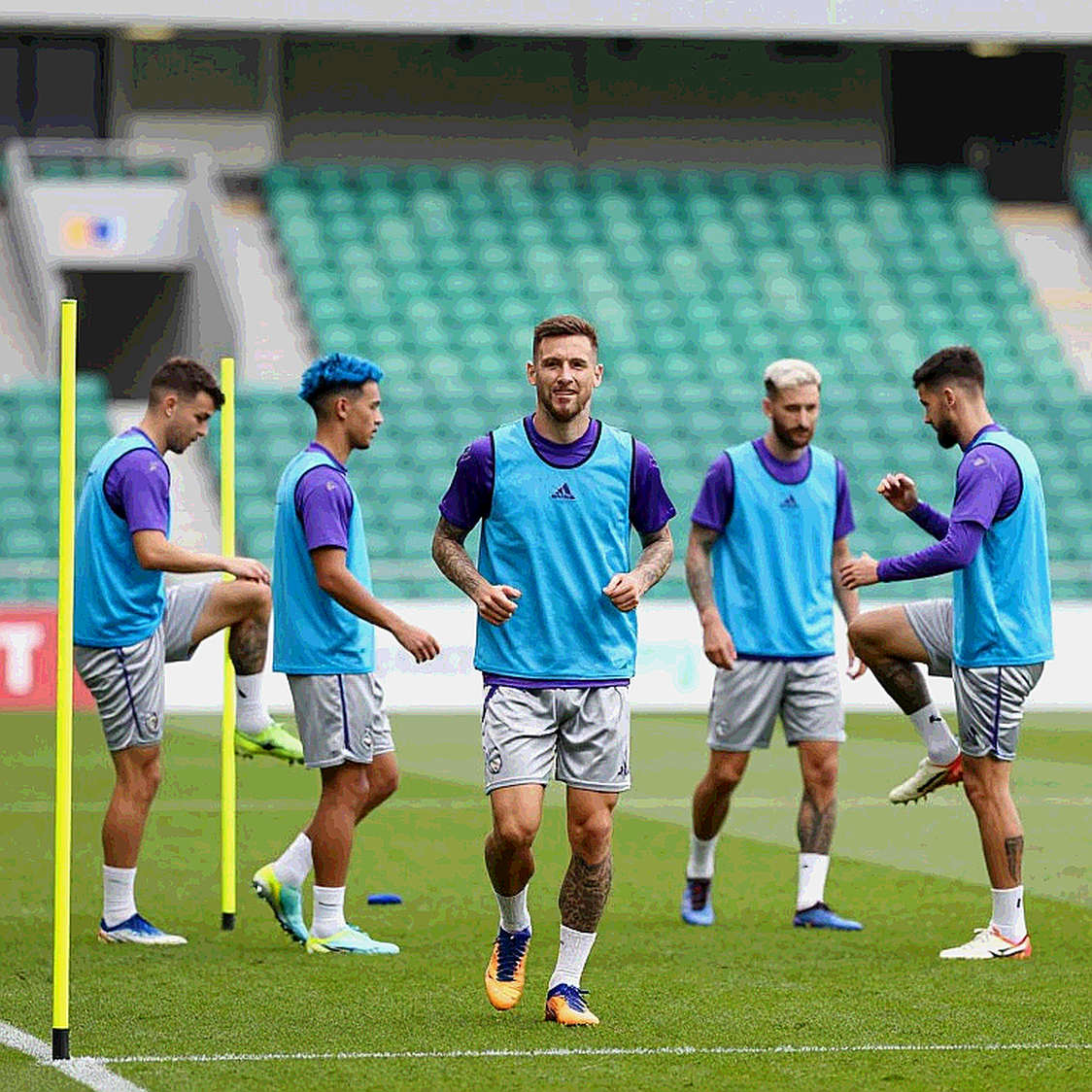
A festival with its own rulebook
The FIFA U15 World Cup & Festival 2026 runs from 24 to 30 October 2026 in Azerbaijan under the motto "Give Every Talent a Chance". The title has two halves, and the second half is the honest one: this is a youth football festival, where results rank below international exposure.
Group R contains six teams from four confederations: Vietnam, Iran and Brunei (AFC), Bosnia-Herzegovina (UEFA), Guyana (CONCACAF) and Mauritius (CAF). That confederation mix is deliberate design rather than the product of a random draw.
The coach is Hoàng Anh Tuấn, whose record sits in the development tier rather than the results tier: qualification for the 2026 U20 World Cup with Vietnam, and the 2026 U23 Southeast Asian title. Appointing a coach of that profile to a U15 squad is not a trophy-hunting move. It is closer to sending a chief engineer to open a new site than hiring a dealmaker.
And there is a substantial body of rules that a service piece typically compresses into three bullet points: eight players per side, a smaller pitch, standard-size goals retained, offside enforceable only in the attacking third, and kick-ins replacing throw-ins.
Those four lines describe a different civilisation.
The geometry of a goal that refuses to shrink
A standard eleven-a-side pitch is roughly 105 by 68 metres, shared between two goals 7.32 metres wide. Shrink the pitch while keeping the goal fixed and the ratio of goalmouth to pitch area rises sharply. This is arithmetic any goalkeeper understands instinctively: the distance from the shooting point to the goal shortens, but the target you have to hit does not get smaller.
The immediate tactical consequence is that the geometry which normally protects defenders through distance disappears, so teams with good long-range shooting and good crossing gain disproportionately. In eleven-a-side, a shot from 25 metres is a gamble because the probability of hitting that 7.32-metre frame from that range is low. On a smaller pitch, a shot from 20 metres becomes a reasonable attacking option — worth drilling, worth planning for.
It also inflates the value of physical size. Within a single age group, the team with more early developers, taller and stronger in duels, benefits at both ends. Aerial balls into the box were already dangerous; they become more dangerous when there are fewer bodies in the area and shorter distances to cover.
Among the seventeen information points available to me there is not a single performance metric: no xG, no PPDA, no possession figures, no duel counts. No match has been played. Every tactical claim here is therefore inference from rule structure, not from match data. I state that plainly so the reader knows what they are reading.
The truncated offside line
Of the four changes, this is the heaviest and the least discussed. Offside is enforceable only in the attacking third. A striker can stand beyond the last defender from midfield and receive the ball unchallenged, provided he has not yet crossed into the final third.
The consequence is easy to picture. A high defensive line — the most widespread weapon of modern football, used to squeeze opponents into their own half — loses its insurance policy. The offside trap no longer exists in midfield. Any team that pushes up without a trap will be attacked behind, repeatedly, in a straight line, by simple long passes.
The new law rewards a low block and direct counter-attacking, effectively inverting the value axis of elite contemporary football. A team that sits deep, holds its distances, concedes possession and waits for one ball over the top enjoys a structural advantage. Meanwhile the high-pressing side, the default of developed football nations, is playing a game where the pitch no longer covers for it.
For Vietnam U15 this may be structurally good news and behaviourally bad news. Good: a disciplined low block is something you can build in three days, far faster than a complex pressing system. Bad: Vietnamese youth players are trained in an environment where the defensive line drifts high by instinct, and instinct does not yield to a single team meeting.
From throw-ins to kick-ins
Throw-ins are the least respected and least coached phase in football. A kick-in is different. A ball placed on the line can be struck with the inside, the outside, curled, or drilled low. It converts a dead ball into an organised set piece.
The value of the specialist wide ball-winner falls; the value of the two-footed technician rises. Moments that once let a full-back use strength to win possession back with a long throw now become moments for the opposition to build. At U15 level, where individual technical gaps are wide, this change can create a bigger margin than most people expect.
It also cuts dead time. A kick-in taken in three seconds replaces a throw-in stretched over fifteen with ball-wiping, position-adjusting and thrower-swapping. If FIFA's objective is more touches per player per minute, this piece fits neatly.
Read together rather than individually, the four changes point in one direction: more touches, more one-versus-one situations, more goals. This is a trial package from an organisation deliberately turning a tournament into a law laboratory — not the idle tinkering of a bored organising committee.
Seventy-two hours is a management problem, not a fitness problem
The squad flew to Azerbaijan on 21 October 2026. The first match is on 24 October 2026. Three days, including flight time, time-zone adjustment, eating and sleeping for fourteen-year-olds, and the time needed to install new laws into players' feet.

I once sat in a youth national team meeting room three days before an international tournament, and what I remember is not the tactical drills. I remember the staff having to choose: teach the new or reinforce the old. You cannot do both in 72 hours.
For Hoàng Anh Tuấn, this is a prioritisation problem rather than a technical one. He can build a low block in three days. He cannot retrain the positional reflexes of a cohort that has played eleven-a-side since the age of nine. The rational choice is to simplify: hold distances, do not push high, take set pieces seriously, treat kick-ins as dead-ball situations, and concentrate everything on not conceding inside the first fifteen minutes.
One detail bothers me. Public information about this tournament includes no squad list. Not a single name. No positions, no heights, no preferred foot, no parent clubs. In a tournament where personnel is the most important variable, we are discussing a team with no concrete identity.
Group R and the real order of difficulty
By confederation-strength logic, Bosnia-Herzegovina is the hardest opponent Vietnam will face in the group. A UEFA nation embedded in the European youth development system, with football tradition and institutional resources that smaller Asian federations do not have. Iran is the second-most daunting, with the stable youth infrastructure of a major regional football nation.
That makes the opener Vietnam's hardest match — and also its lowest-risk match in media terms. Losing to a UEFA side in game one is a predicted outcome. At U15 level, public pressure after such a defeat is close to zero.
There is a counter-argument I find more worth weighing: a small pitch and eight players compress the physical gap between a Southeast Asian team and a European one. In eleven-a-side, a large pitch gives the stronger team room to stretch play, to use speed and physique to suffocate the opponent. When space is compressed, small, skilful, quick-processing players find more room to survive. That is why Asian futsal and street football rarely show the same gap with Europe that eleven-a-side does.
I do not push that argument too far. It is a hypothesis, not a conclusion.
Six teams, seven days
The tournament runs from 24 to 30 October 2026. Group R has six teams. The simple arithmetic implies two to three matches per team inside seven days, on a pitch with unfamiliar dimensions, with a shorter recovery window than youth football normally allows.
This is the least discussed risk in the whole story. Fourteen-year-olds do not recover like adults, and they are not used to three matches in a week. Add a long flight from Vietnam to Azerbaijan, and pre-tournament physical screening becomes more decisive than any formation.
With a coaching staff whose squad is not public, the only way to read this risk is to watch minutes across matches. If a core group plays nearly all three games, that signals insufficient depth to rotate.
FIFA sells direct to the viewer
No Vietnamese broadcaster bought this tournament. Instead the entire output sits on FIFA+, the streaming platform operated through DAZN, free, with match sessions already visible in its catalogue.
There are contracts signed on the pitch, and contracts signed in the dark. Here, what was signed behind closed doors is distribution. FIFA is not selling the tournament market by market under the traditional model. It is delivering the product straight to viewers through its own infrastructure, cutting out the entire middle layer of broadcasters, distributors and local-language commentary packages.
For Vietnamese viewers, the cost of watching is zero. For the Vietnamese football ecosystem, rights revenue from a tournament like this is also zero. Those two figures are not contradictory; they are two faces of the same decision. No domestic broadcaster means no Vietnamese-language coverage, no local advertising inventory, no commercial loop activated around a national team.
I once sat in a café in Moscow in 2026 and listened to a man tell me things it would take me years to verify. I went to Moscow to watch football, but I left with a different life. Since then, whenever I see a tournament staged with nobody selling it to the local audience, I no longer read that as accident. I read it as a decision taken at a higher level.
The information vacuum
I keep a notebook, and it does not record goals. It records dates, names, phone numbers, account numbers, and questions without answers.
On this story, the notebook has very little. No squad list. No goalkeeper's name. No injury status. No physical data. No information on the pre-departure camp, though one can infer a gathering existed before 21 October 2026. Not a single named scout from FIFA or from European clubs tracking Group R.
A tournament promoted under the slogan of giving every talent a chance has not published the names of those talents. That may be a defensible decision: protecting minors from premature media cycles. It may also be the consequence of a tournament that has not been invested in commensurately.
Distinguishing those two matters, and I lack the evidence to conclude. What I know is that the quality of analysis fans receive is proportional to the information released, and here the information released is close to nothing.
The reasonable part of the opposing view
There is another reading, and it is not naive.
First, the absence of a Vietnamese rights buyer is very likely a rational commercial decision rather than a snub. A U15 tournament draws a narrow Vietnamese audience, and the cost of producing a Vietnamese commentary feed for the whole event may exceed what a broadcaster would pay. In media economics, an unbought tournament usually means it is not big enough, not that it has been boycotted.
Second, my own argument about a small pitch compressing the physical gap cuts both ways. If the format turns matches into high-scoring affairs, result variance falls and luck rises. When luck matters more, the class gap between teams compresses too. In that sense, Vietnam U15 may gain more than it loses.
Third, the development framing used by organisers and the team is a double-edged shield. It protects young players from results pressure, and it also protects the coaching staff from every question about outcomes. Once any defeat can be explained with the word "learning", no standard remains for evaluating a staff's work. I am not saying that is wrong. I am saying it should be recognised.
Fourth, the assumption that European federations hold a decisive edge at 8v8 is weak. Asian youth football is full of small-sided play — in alleys, on futsal courts, in referee-less three-on-three. Vietnamese children raised in tight spaces may adapt to a small pitch faster than children drilled on full-size pitches from the age of nine.
On one point I do not concede. Three days is three days. No street-football culture substitutes for rehearsing a specific rulebook as a unit, and no individual skill fixes a defensive line that does not yet know whether it is allowed to push up.
What to watch after the whistle
The result of Vietnam U15 against Bosnia-Herzegovina on 24 October 2026 will go into the Group R table and be forgotten within a week.
What lasts longer is the rule package. If these four changes run smoothly in Azerbaijan, they will reappear at more age groups, in more federations, and eventually inside national youth curricula. The fourteen-year-olds of today will then be the first generation to learn football under a rulebook different from the one their parents watched.
The question I want to leave is not whether Vietnam win or lose. It is this: who benefits when a tournament for fourteen-year-olds is staged under experimental laws, streamed free on a global platform, with no broadcaster from any participating country buying the rights, and without publishing the name of a single player?
If the answer is "FIFA", then at least we should know what we are watching.